
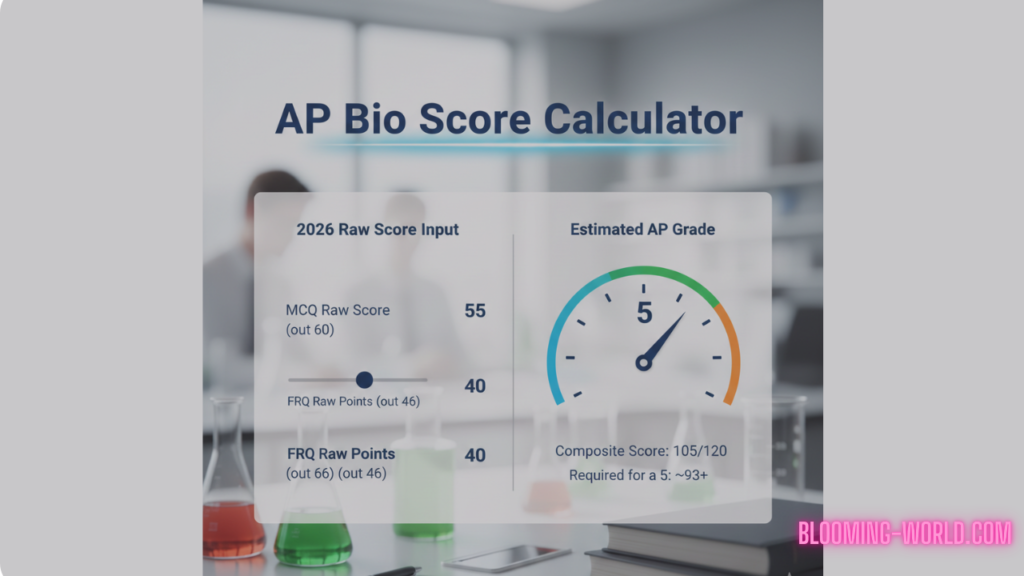
AP Bio Score Calculator will Calculate your potential score on the AP Biology exam shouldn’t feel as complex as the Calvin Cycle. While the College Board doesn’t release the “official” curve until after the exams are graded, we can use historical data and the current 2026 weighted scoring system to give you a highly accurate prediction.
Whether you just finished a practice test or are nervously staring at a stack of FRQs, this guide breaks down exactly how your raw points translate into that coveted 5.
Estimate Your 2026 AP Biology Score
To get a quick estimate, follow this standard weighting formula used by most high-level AP Bio score calculators:
| Section | Questions | Weighting | Calculation |
| Section I: Multiple Choice | 60 Questions | 50% | (Raw Score) × 1.03 |
| Section II: Free Response | 6 Questions | 50% | (FRQ Points) × 1.4 |
| Composite Score | Total | 100% | Section I + Section II |
Pro-Tip: A composite score of 95+ typically lands you a 5. A score of 75-90 is usually a solid 4.
How the AP Bio Scoring System Works in 2026
The AP Biology exam is a game of two halves. To master the AP Bio score calculator, you need to understand how each section is tallied and weighted.
Section I: Multiple Choice (MCQ)
This section contains 60 questions. In 2026, there is no penalty for guessing. Your raw score is simply the number of questions you got right.
- Total Raw Points: 60
- Weighted Contribution: 50% of your final score.
Section II: Free Response (FRQ)
The FRQ section is worth 46 raw points, but it is scaled to match the MCQ section’s 50% weight.
- 2 Long Questions: (8–10 points each) Focus on interpreting experimental results and graphing.()
- 4 Short Questions: (4 points each) Focus on scientific investigation, conceptual analysis, and data modeling.
2026 Raw to Scaled Score Conversion Table
Because the “curve” shifts slightly based on the difficulty of the national exam, these ranges are estimates based on the most recent 2025 and 2026 scoring distributions.
| Composite Score Range | AP Grade | Recommendation |
| 93 – 120 | 5 | Extremely Well Qualified |
| 75 – 92 | 4 | Very Well Qualified |
| 60 – 74 | 3 | Qualified (Passing) |
| 45 – 59 | 2 | Possibly Qualified |
| 0 – 44 | 1 | No Recommendation |
The “Curve” Explained: Why a 70% is Often a 5
One of the biggest surprises for students using an AP Bio score calculator is discovering that you don’t need a 90% to get a 5. In fact, most years, earning roughly 75% of the total available points will land you in the top scoring bracket.
This “curve” exists because the College Board wants to ensure that a 5 in 2026 represents the same level of mastery as a 5 did in 2015. If the test is exceptionally difficult, the composite score required for a 5 may drop slightly.
Strategy: Where to Pick Up “Easy” Points
- Don’t leave MCQs blank: Since there’s no “wrong answer” penalty, a blind guess is better than a blank bubble.
- Label your graphs: In Section II, you can often earn 1-2 points just for correctly labeling axes and plotting data, even if your analysis is shaky.
- Identify vs. Explain: In FRQs, “Identify” usually requires one word or a short phrase. “Explain” requires a “because” statement. Don’t waste time writing a paragraph for an “Identify” prompt.
Frequently Asked Questions (FAQs)
What is a passing score for AP Biology?
A score of 3 or higher is generally considered passing. Most state universities grant credit for a 3, though elite or “Ivy Plus” institutions often require a 4 or 5 for credit or placement into advanced-level courses.
Is the AP Biology exam curved?
Technically, it is “norm-referenced.” This means the raw-to-scaled conversion is adjusted so that the difficulty of the exam remains consistent year over year. While not a curve in the traditional sense (where students compete against each other), it functions as one by lowering the threshold for a 5 if the exam is harder.
How many FRQs are on the AP Bio exam?
There are 6 free-response questions in total: 2 long-form questions (interpreting data and experimental results) and 4 short-form questions. You have 90 minutes to complete the entire section.
Can I use a calculator on the AP Bio exam?
Yes! A four-function, scientific, or graphing calculator is permitted for the entire exam. Make sure your model is on the College Board’s approved list for 2026.
What percentage do I need for a 5 in AP Bio?
While it varies, you typically need to earn approximately 75-80% of the total weighted points to receive a 5. Using an AP Bio score calculator can help you visualize how your MCQ and FRQ performance work together to reach this threshold.